Used Ultrasound Export UK: Prove Equipment, Not Waste
Same symptom on your system?
Tell us your model and what it is doing. A GEPROBE engineer replies with a diagnosis path, part options and pricing — usually within 6 hours, with no obligation.
Chat on WhatsApp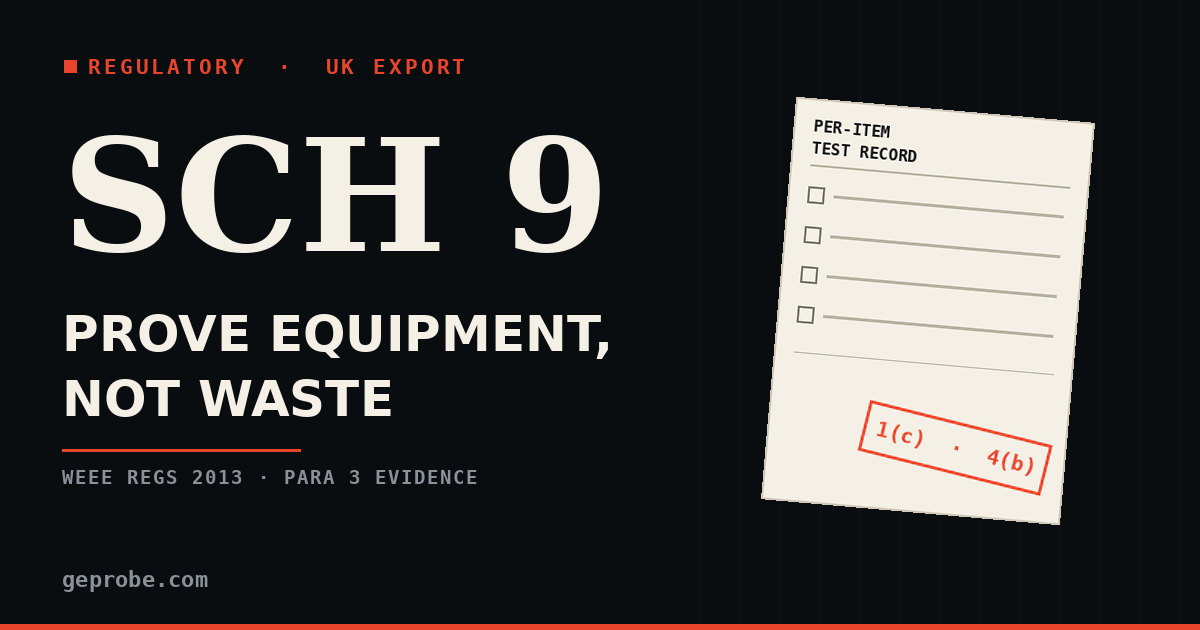
A used ultrasound export UK shipment gets one question before any other: is this machine still a working instrument, or has it turned into waste?
UK law puts the answer on the party claiming used EEE status. Schedule 9 of the WEEE Regulations 2013 sets out the proof that claim needs.
General guidance on that proof is built around a console on a pallet. This article takes the two cases such guidance leaves out: crates of transducers, and the buyer at the far end.
Why a transducer fails an inspection that a console would pass
Schedule 9 asks for testing that shows an item works. On a console the evidence surface is the machine itself: it boots, images, measures, stores and prints its own result.
A loose transducer has no imaging engine inside it. Its key functions exist only while it is coupled to a host system that is not in the crate.
So a probe-only record answers a narrower question than an inspector asks. It can show that something was tested; it cannot show what the test was run against.
Add a reference-host line to every transducer record: host make, model, serial, software version and the port used. A dedicated probe analyser counts, if the record names it.
| Item in the consignment | Evidence a console needs | Evidence a transducer needs |
|---|---|---|
| Console, cart or portable | Boot to imaging, measurement, storage and export, tied to the chassis serial | Not applicable |
| Transducer sold with a system | Probe serial on the per-item record, matched to the chassis record | Same record, plus host model, serial, software version and port |
| Transducer sold alone | Not applicable | Host or analyser identity, because the probe cannot prove function by itself |
| Where the record is attached | On the unit, or on the outer crate if packed | On the transit case or carton, never on the acoustic window |
| Company named as responsible | Whoever signed the test | Whoever signed the test, including an outside test house |
Table 1: what changes when the item is a probe rather than a console. Editorial comparison, not statutory text.
What Schedule 9 asks for, mapped to four events
Read as a timeline, the schedule attaches one document to each stage of the deal, and dates each one to a different moment.
- Sale: the sale paperwork, meaning an invoice and the contract recording transfer of title, both stating direct re-use and full function.
- Test: a copy of the records for every item in the consignment, plus a protocol carrying the fields listed in paragraph 3.
- Signature: a declaration, from whichever party arranges carriage, that no item in the load is waste.
- Load: packaging and stacking that protect the goods, a transport document such as a CMR or waybill, and a liable-person declaration.
Paragraph 3 also asks for a hazardous-substance evaluation. Boards, cables and mouldings are where brominated flame retardants appear; the Annex IV limit is 500 mg/kg for the five summed PBDEs.
Paragraph 5 is the hinge. Fail the paperwork or the packaging and the authority must treat the item as WEEE and presume an illegal shipment.
From there the file leaves environmental law for waste-shipment law: Regulation (EC) No 1013/2006, take-back, and a bill.
Two declarations, two different signers
Paragraph 1(c) and paragraph 4(b) both want a signature. They are not the same signature, and packs fall apart when one person signs both.
1(c) sits with the holder who arranges the transport. 4(b) sits with the liable person, signing on their own responsibility.
Sell on delivered terms and the arranging holder may sit abroad. Sell ex works and it may be your buyer's forwarder, who never saw the unit tested.
Settle both roles in the contract before the pack is built. Otherwise one declaration arrives from a party with no standing to give it.
| Clause | Duty | Who usually performs it | What a buyer can check |
|---|---|---|---|
| 1(a) | Invoice and contract stating direct re-use and full function | Seller | The wording does not disclaim function |
| 1(b), 3 | Per-item test records and the protocol | Tester, often not the seller | Host identity, test date, signature, scope |
| 1(c) | Declaration that the load is not waste | Holder arranging transport | Name, entity, date, and that role in the contract |
| 1(d) | Packaging and stacking | Whoever packs the crate | Photos taken before sealing, inner blocking |
| 4(a), 4(b) | Transport document and liable-person declaration | Forwarder and importer of record | Numbers that match invoice and test records |
Table 2: who performs each duty, and what the other side can verify.
Paragraph 2 removes 1(a), 1(b) and 3 where a documented business-to-business repair or refurbishment transfer applies. It leaves 1(c), 1(d) and 4 standing, which is why a repair shipment still needs two signatures.
Where the per-item record lives, and when it stops being evidence
Paragraph 3 wants the record attached to the item, or to the packaging when the item is packed, and readable without opening the box.
On a transducer the only sensible surface is the case or the outer carton. Nothing goes near an acoustic window, and nothing goes on a handle a clinician grips.
The record also has to name the company responsible for the evidence of functionality, with an address. That is the tester, not necessarily the seller.
When an outside workshop ran the test, the workshop is the company named. A UK seller's file then stands or falls on that workshop's method.
Nothing in the schedule sets an expiry date, and an inspector will not read one into it. Records still age, because their subject changes.
Write re-test triggers into your procedure: firmware change, a different host, a repair after the test, a re-mated connector, or a long gap before departure.
If you are the buyer: six cross-checks before payment
An importing clinic carries the same risk from the far side. A thin pack of export documentation usually shows up as a contradiction between documents, not as a missing folder.
- Nameplate serial matches the invoice, the per-item record and the transport document.
- The test date falls before collection, not after it.
- Each transducer has its own record; one certificate covering six probes is not per-item evidence.
- Transducer records name the host system and the port used.
- The waste declaration carries a name, an entity and a date, and its signer arranged the transport.
- Packaging in the file matches what arrived: inner blocking, probes boxed separately, no loose scrap in the crate.
Two contradictions should hold up a payment: a contract disclaiming function beside a record claiming full function, and failed boards crated with working probes.
Mixing has its own rule. Environment Agency reuse conditions require that EEE for reuse is not transported with waste; mixed without a clear split, all of it becomes waste.
Costing a thin pack: remedy, return, or re-route
Three options exist once the pack is weak: fix the evidence, ship and carry the risk, or sell the goods as parts instead of a system.
| Option | Direct cost | Exposure | Wins when |
|---|---|---|---|
| Remedy the pack | Tester time, host time, re-crating | Delay to the sailing | The gap is documents, not test access |
| Ship as it stands | Freight as booked | Take-back, storage, return freight, and the sale | The chance of a stop is very low |
| Re-route as parts | Loss of system value | Parts must genuinely be parts | The unit cannot pass a functional test |
Table 3: three responses to a defective evidence pack.
A workable comparison: expected loss = P × (2F + S × D). P is the chance of a stop, F one-way freight, S storage per day, D days to resolve.
Take-back runs on a 30-day clock under Article 24(2), and Article 25 charges the cost to the notifier, storage included from the day the authority learns of the shipment.
Example with invented numbers: F 1,800, S 45, D 30, P 0.3 gives 0.3 × (3,600 + 1,350) = 1,485. A remediation quoted at 900 is the cheaper line.
If the arithmetic runs the other way, check whether the goods are really parts. A unit dismantled for its transducers has been discarded; those transducers are waste until they pass an end-of-waste test.
What GEPROBE can and cannot put in your file
GEPROBE supplies new, used and refurbished original transducers and compatible probes, plus ultrasound parts listed by OEM part number for service and refurbishment work.
Repair intake produces a test report and a cosmetic checklist, and probes are verified on original host systems before they go back to a facility.
That is technical evidence for your file. It is not a waste determination, and GEPROBE is not a regulator, an approved exporter or a customs broker.
One boundary belongs in writing. A third-party facility outside the OECD does not fit the paragraph 2(b) refurbishment route for professional equipment.
A defective UK unit shipped one way to an overseas workshop therefore raises a different question from a probe sent out and returned to the same holder.
If that reading applies to your case, keep the unit in the UK until it tests clean, then export it with a record that stands on its own.
Sources and access dates
WEEE Regulations 2013, Schedule 9 (SI 2013/3113) — reviewed 10 November 2026.
Environment Agency, When EEE becomes waste (WEEE) — reviewed 10 November 2026.
Environment Agency, Importing and exporting WEEE — reviewed 10 November 2026.
Regulation (EC) No 1013/2006, Article 24 (take-back) — reviewed 10 November 2026.
Regulation (EC) No 1013/2006, Article 25 (costs) — reviewed 10 November 2026.
Regulation (EU) 2019/1021, Annex IV (PBDE limits) — reviewed 10 November 2026.
GEPROBE, ultrasound probes catalogue — reviewed 10 November 2026.
GEPROBE, ultrasound parts catalogue — reviewed 10 November 2026.
GEPROBE, repair services — reviewed 10 November 2026.
All statutory and regulatory text above was read at the linked page on the date shown. Prices and freight figures in the cost example are illustrative assumptions, not quoted rates.
Related Articles
DICOM Photometric Interpretation vs. Color Doppler in PACS
Color Doppler that looks wrong in PACS is usually an encoding question, not a probe fault. A four-point check, a ship gate, and the arithmetic.
Ultrasound Transducer Useful Life: A Buyer's Decision Path
Cycle count, not manufacture date, decides what a used probe can still support. Screening fields, acceptance evidence, and arithmetic you can run.
Ultrasound USB DICOMDIR Viewer No Study: Four Layers
Files sit on the USB drive but the viewer lists no study. Work the four layers — media, naming, index, receiver — and know when the console is the fault.